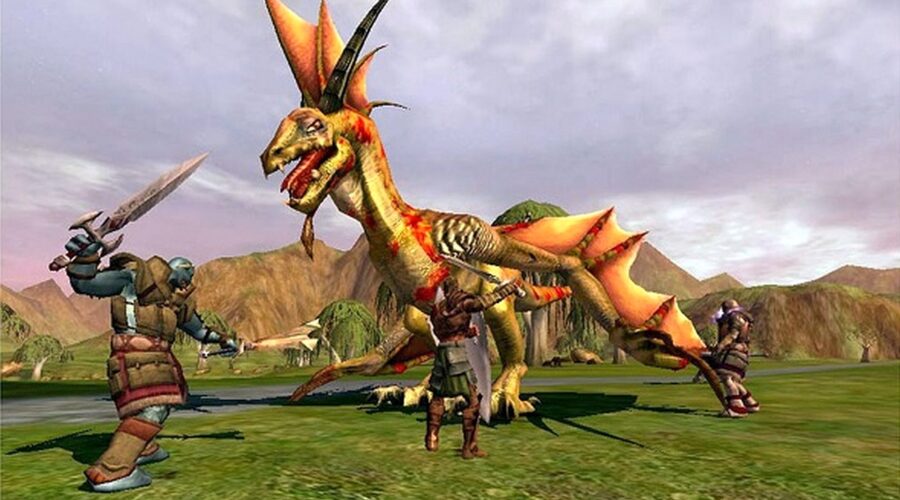
Seems like a trivial question. But given the recent fallout from the Eurogamer review of Darkfall, it's a question worth exploring.
In case you missed the circus, here is the firebrand Darkfall review from Eurogamer, in all its glory, with a record low 2/10 score. And here is Aventurine's response. And Eurogamer's counter-response. And Aventurine's counter-counter-response. All fun and games so far.
For mine, I felt the review was indeed harsh, but interestingly it resonated with a certain percentage of the population (including myself), as backed up by many of the 1,000-odd comments following the review. Yet, pivotally, it resonated in the exact opposite way with another percentage of the population - I'm loath to call them Darkfall apologists - but despite their vitriol, it's clear they love the game.
So how can we have a review of a product that is so polarising? Does this mean it's a bad review?
Short answer: yes.
What Is a Review?
Long answer: I've long wrestled with the notion of what makes a good review from three distinct perspectives: as a journalist and game reviewer myself; as a commissioning editor of games reviews; and as a gamer. But I've come to a conclusion that instead of defining a review by what it is, it's better to define it by what it's for; a functionalist defnition, if you will.
So in that sense, a good review serves three main functions:
- It describes: it informs the reader about a game and what it's like to play it.
- It judges: it advises the reader on whether they should or shouldn't buy the game.
- It entertains: it should be an enjoyable tract of prose for a game-playing audience.
Of these, I'd suggest only (2) is a sufficient condition, but (2) alone isn't a great read. Likewise, (1) and (3) together might be an enjoyable piece of game writing, but without the critical aspect, it doesn't make a good review. Whether a review is good or not rests on the execution of these three functions. And it's in this sense that the Eurogamer failed, at least on (1) and (2).
More Than the Facts
In terms of description (1), it's clear from the comments that Zitron's review contained factual errors. Either Zitron didn't take the time or do enough research to understand the way the game worked, or just didn't get it. The crazy thing about Darkfall is, despite it's seemingly crazy design, it's not accidental - it's exactly the way Aventurine want it! Zitron seemed to see odd design choices as a failure of execution when, in fact, they weren't. And this influenced his judgement of the game (2).
Necessarily, all game reviews are going to have an element of subjectivity to them: does the reviewer enjoy more strategic to tactical gameply? Do they enjoy firey visceral games or story-driven narrative games? The type of gamer the reviewer is will influence whether they enjoy the game, which in turn could influence what they write in the review.
However, many good game reviewers will attempt to transcend their subjective impressions (although without ignoring them) to imagine whether other types of gamers might enjoy the game. Some don't. But they wear their subjectivity on their sleeve; they're saying 'I loved/hated this game, and if you're like me, you'll love/hate it too.' But mainstream game reviewers on general gaming sites - like Eurogamer - can't presume their audience has any particular disposition and they have to cater for the full spectrum of gamers.
This is where Ed Zitron fell over with the Darkfall review. He a) called it as he saw it, and b) didn't flag up front that he was doing so. So he failed with condition (2) of the function of a review: to advise. He might have assumed the vast majority of his readers were like him. But he was wrong. Enough of them disagreed with his judgement to make his objective-seeming 2/10 look ridiculous.
The Score
Which brings me to scores. Dave particularly hates scores. And I agree with him. A score locks down the judgement to one figure as if it applies to everyone. But a game that is brilliant to a strategy enthusiasts might tank for an action enthusiast. We all know that. But scores persist. Should they?
Well, I think there's one area where scores are useful: execution. A game can vary all over the shop in terms of gameplay and what kinds of gamers it will satisfy. But even if a game is intended for strategic gamers, if it's execution sucks, then it's not going to appeal to anyone.
What is execution? Things like performance, interface, balance, difficulty, the manual, the tutorial, consistency, grammar etc. These things don't necessarily impact to whom the game appeals, but they do turn a great concept into a great game - or a great concept into a pile of crap.
In this sense Darkfall is a funny beast, as I mentioned above. Although it does seem reasonable to mark it down for the lack of a tutorial and some of the more clumsy elements. But not for things like not being able to move while looting - that's a deliberate decision, and seems to have been executed well, even if you don't like the decision.
Second Opinion
I must say, I'm looking forward to the second review by Rock, Paper, Shotgun's Kieron Gillen. I'm particularly interested to see how he differs from Zitron in his description of the game, and how that influences his judgment. I'm also interested in whether he acknowledges that there are some people in this world - strange, psychopathic people, maybe, but gamers none the less - who will love the game.
In any case, I think it was the right thing to do for Eurogamer to both stick up for Zitron - any editor worth his or her salt would do the same for a valued writer, even if they think the writer screwed up (although you can be certain Tom Bramwell unleashed both barrels on Zitron in private) - and for them to commission the second opinion. We await it with anticipation!